Pride, status and hormones:
Rejectors in an ultimatum
game have high levels of Testosterone.
© Terence C. Burnham
Visiting Assistant Professor
John F. Kennedy School of Government
Harvard University
950 Massachusetts Avenue, #313
Cambridge, MA 02139
terry@post.harvard.edu
June 6, 2000
Pride, status and hormones:
Rejectors in an ultimatum game have high levels of testosterone.
June 6, 2000
Abstract
26 male subjects participated in a $40 ultimatum game. Offers were constrained to either $5 (stingy) or $25 (generous); all pairs were paid. The subjects’ testosterone levels were assayed using saliva samples. Subjects who rejected stingy offers had significantly higher testosterone levels than subjects who accepted stingy offers (p = .001). Of the seven subjects with highest testosterone levels, five rejected the stingy offer. Of the nineteen subjects with the lowest testosterone levels, only one rejected the stingy offer.
Introduction
This paper investigates the role of testosterone in an ultimatum game. It is motivated by three findings: First, there is substantial heterogeneity in economic behavior, often labeled as types. This is seen most clearly in experimental settings where subjects face identical payoff structures and information. In these experimental settings, there is substantial between-subject variation even in games where economic theory makes unambiguous predictions to the contrary.
The second area is costly breakdowns in negotiation. In experimental conditions this is demonstrated most cleanly in ultimatum games (Guth, Schmittberger et al., 1982) where rejection rates are significantly greater than zero. Roth (1995) provides a summary of this literature, and points out that the experimental results agree with field data in settings ranging from labor strikes to malpractice suits.
The third area of relevance is the notion that emotions serve as commitment devices for equilibrium strategies that involve punishment (Schelling, 1978; Hirshleifer, 1987; Frank, 1988). This view sees emotional states such as anger as a method for implementing costly punishment strategies.
These three ideas motivate this study in the form of the following questions: Where do types come from? Why do negotiations fail so frequently? What is the role of emotion in punishment strategies?
The hormone testosterone is a prime mediator of male behavior in many settings and across a wide variety of species. In particular, testosterone levels correlate with a number of important individual traits, and experimentally induced changes in testosterone alter behavior.
Recent methodological advances allow the measurement of testosterone via saliva samples (previous methods used blood). Human subjects spit into specially prepared tubes, and the samples remain useful for many months even at room temperatures. This stability allows for easy home collection and also for use in anthropological settings where refrigeration is unavailable. The marginal cost of obtaining one testosterone reading is on the order of $10.
Testosterone is
therefore a leading candidate to investigate the economic behaviors discussed
above. It is an important mediator of behavior, it is relatively easy to assay,
and it is virgin ground within economics. Because measuring testosterone in an
experimental economic setting is new, using a very well-studied game embeds the
results within existing data. For these reasons, only games that have been
extensively played were considered, and among these the ultimatum game was
selected to best address the questions of types, negotiation failure, and
emotions.
The body of this paper
is structured as follows: First, a brief review of the role of testosterone in
behavior. Next, the experimental design. The paper concludes with results and
discussion. The complete experimental instructions and subjects’ strategies in
the constrained ultimatum game are attached as appendices.
Testosterone and Behavior
Before beginning this discussion, a brief disclaimer is merited. This paper only deals with the role of testosterone in males, both in review of the theory and in using male subjects. The reasons are straightforward, but one unfortunate outcome is an additional paper on men within the broader context of medical studies that have under-represented women.
The reason for using men is twofold. First, testosterone is a primary mediator of male behavior, and plays a less central role in female behavior. Second, the mechanisms of action are very different in males and females and the specific techniques elucidated in this study have either been shown to be unimportant in women or have not been addressed in the literature. Since this paper is the first to bridge experimental economics and biological mechanisms, the best-studied areas of both are used — an ultimatum game with male subjects.
A biosocial theory of testosterone and male behavior
Testosterone level is a powerful mediator of male behavior and is, in turn, changed by behavior. Several researchers (Mazur, 1985; Kemper, 1990) have put forth an adaptive “biosocial” hypothesis for the testosterone-behavior interaction. The rest of this section briefly describes the biosocial model and the subsequent sections deal with the sub-arguments in more detail.
The biosocial model starts by observing that optimal behavior, particularly with regard to costly aggression, depends crucially on likelihood of victory. In particular, powerful people (high ranking) are posited to have lower costs associated with aggression and therefore should, ceteris paribus, be more willing to engage in costly fights.
Testosterone is hypothesized to be the mechanism for varying behavior as a function of rank. Since rank is highly variable based on factors with stochastic elements such as injury, death of rivals, and nutritional status, an optimal system must continually monitor and alter behavior accordingly. In other words, preprogrammed aggression levels, independent of current state, would be less successful than contingent behavior. This system is implemented in two parts. First, animals consult (subconsciously) with an internal oracle (testosterone level) when choosing behaviors; second, testosterone levels are continuously updated with new information about relative rank.
High testosterone males act differently than low testosterone males. Commonly thought of as simply being aggressive, high testosterone males are more appropriately described as being willing to be aggressive. If challenges are common then testosterone may be correlated with aggression, but in other settings testosterone will be inversely correlated with aggression.
The idea that testosterone levels change with new rank information is supported by settings where interactions can be coded into wins and losses. Specifically, in a variety of settings winners’ testosterone is significantly higher than losers’ testosterone in the few hours after competition. Studies demonstrate these competitive profiles for human male testosterone levels in interactions ranging from wrestling to chess to coin flips (Elias, 1981; Gladue, Boechler et al., 1989; Mazur, Booth et al., 1992).
So the biosocial model has human males constantly assessing and updating rank by keeping track of male-male interactions. Wins in such interactions increase testosterone levels and a sequence of wins leads to higher testosterone levels and increased likelihood of behavior appropriate for a high-ranking male. Similarly, losses indicate that self-assessment of rank ought to be lowered and testosterone drops. With this as a framework, the next sections discuss some of the data and theory in more detail.
Testosterone levels correlate with, and affect, behavior
Testosterone is an important mediator of male behavior across a wide variety of species. High ranking males have higher testosterone than lower ranking males, and testosterone plays an important role in aggression. In human males, average testosterone varies by profession (figure 1). Professional football players have significantly higher testosterone levels than Ministers, while college professors have testosterone levels very close to those found in unemployed men sampled from a day labor pool (Dabbs, de la Rue et al., 1990).
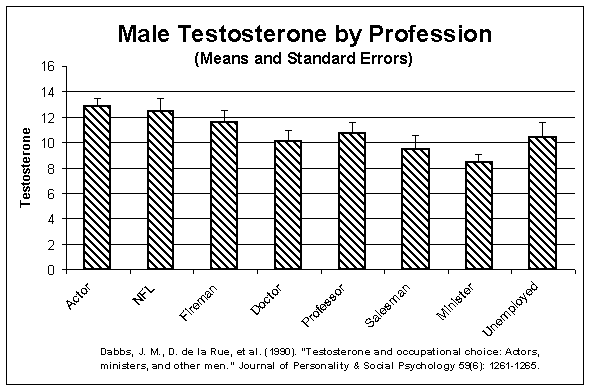
Figure 1: Testosterone and occupation
A crime-related study (Dabbs, Carr et al., 1995), finds no difference between prisoners’ testosterone levels and those of non-prisoners, but within the prisoners finds a positive correlation between testosterone level and disciplinary infractions.
Non-human data conform to the same overall pattern. Chimpanzees (Pan troglodytes) are particularly relevant because they are the closest living genetic relatives of humans and because they exhibit clear dominance hierarchies. This hierarchy is evinced whenever two male chimpanzees interact as one of them produces a vocalization that indicates lower rank. In preliminary studies, rank and testosterone are positively correlated in both wild chimpanzees (Wrangham and Muller, 1996) and wild mountain gorillas (Robbins and Czekala, 1997).
Another strand of the biological anthropology literature looks at nutrition and testosterone levels. Males in industrialized countries have higher testosterone levels (more than double) than those of the Ache foragers of South America and Nepalese males (Bribiescas, 1996; Ellison and Panter-Brick, 1996). Testosterone acts to increase overall muscle mass and with increasing nutrition, males become larger via this pathway.
So testosterone levels are correlated with important characteristics of status and nutrition, both good proxies for costs of aggression. In addition, changes in testosterone cause changes in behavior. Men who are taking anabolic steroids (which cause an increase in testosterone) exhibit higher levels of violence towards their partners (Choi and Pope, 1994). In one of the most economically applicable studies, subjects injected with testosterone were more likely to reduce a fictitious opponent’s payoff than subjects in a control group (Kouri, Lukas et al., 1995).
The cleanest data on the effects of testosterone are in non-humans. Free-living birds of several different species have been given testosterone supplements and observed. T-implanted males of these species decrease the amount of investment in young and spend more time seeking additional mates (Silverin, 1980; Wingfield, 1984; Hegner and Wingfield, 1987). From the perspective of natural selection, additional matings provide males with a benefit, but testosterone supplements also impose costs including increases in fighting. In a study of free-living cowbirds, (Dufty, 1989) 6.3% of T-implanted males were seen one year later vs. 40.7% of controls (p=0.02).
Behavior affects testosterone
The interaction between testosterone and behavior is bi-directional. In particular, human male testosterone levels rise before physical competitions in several settings including tennis, judo, and wrestling (Elias, 1981; Salvador, Simon et al., 1987; Booth, Shelley et al., 1989). In these same studies, testosterone levels drop after competition back to baseline levels with winners' testosterone levels declining more slowly than losers. The differences are statistically significant in the few hours after competition (20-50% higher testosterone in winners approximately one hour after play).
Of significance for social scientists, non-physical competition produces a similar pattern of post-competition divergence between winners and losers. For example, chess match winners have higher post-game testosterone levels than losers (Mazur, Booth et al., 1992).
Two studies highlight the effect of winning and losing independent of any factor which might cause the outcome and be correlated with testosterone levels. In the first study (Gladue, Boechler et al., 1989) subjects competed in a reaction time task where the experimenter lied and randomly assigned winner and loser labels independent of actual performance. In the latter (McCaul, Gladue et al., 1992) subjects publicly observe coin flips to determine the winner of $5. In both studies, testosterone levels are higher in winners than in losers and the pattern is similar to that of physical competition.
Towards a theory of testosterone and optimal behavior
Many of the key elements of the biosocial model are thus supported by the data. High testosterone males behave differently in a fashion that is consistent with the model, and to the extent that experimentally added testosterone changes behavior, it appears to move in the hypothesized direction. The change in testosterone as a function of winning and losing is robust, and is consistent with a rank updating system.
At least one open area exists; the theory suggests that long-term changes should result from a series of wins and losses. The observed changes in testosterone due to winning and losing are short-lived and there does not appear to be any data, in either direction, on long-term changes in testosterone.
Experimental Design
Overall Design
The goal is to evaluate the effect of both base testosterone levels and changes in testosterone on ultimatum game behavior. Base testosterone levels were measured on three non-experimental days, and six measurements were taken within the three hour experiment.
A pregame exercise was played with the goal of generating short-term testosterone changes between two groups of subjects. Specifically, the literature discussed above finds significant changes in testosterone levels due to a winning and losing effect. The pregame exercise used in the experiment was designed to evoke the competitive effect.
The design structure was: i) generate short term testosterone changes by game #1 and cash payment, ii) wait one hour to allow hormonal adjustment, iii) play an ultimatum game, iv) pay subjects for ultimatum game, v) take post-payment samples for an additional hour.
Game 1 was designed to produce two groups of subjects with significantly different levels of testosterone relative to subjects’ own baseline; that is, to increase half the subjects’ testosterone relative to the other half of the subjects. After game 1, subjects relaxed for one hour corresponding to the time for generating maximal testosterone differences (Elias, 1981; Booth, Shelley et al., 1989; Dabbs, 1992).
Subjects were paid for their game 1 outcomes immediately, and then the ultimatum strategies (game #2) were elicited one hour later. Subjects were paid for their ultimatum games 30 minutes after their decisions, and stayed for 1 additional hour after ultimatum game payment.
Subjects
30 subjects began the experiment, 26 completed (if a subject missed any of the four sessions he was dropped). All subjects were male students enrolled in a masters degree program at Harvard’s Kennedy School of Government. Each subject had completed a minimum of two semesters of graduate microeconomics including an introduction to game theory.
Methodology for Hormone readings
All the testosterone assays were performed by the author. Testosterone was sampled from saliva using a methodology developed by Peter Ellison and members of his laboratory (Ellison, 1988). Collection tubes were prepared containing a small amount of sodium azide, a substance the prevents bacterial growth and sample contamination. Subjects spit small volumes (3-5 ml.) into vials. The samples were frozen for several months then thawed and analyzed using standard protocols (Ellison, 1988). These well-established procedures involve multiple levels of duplication and error correction.
Testosterone levels vary in predictable fashion throughout the day. The experiment was conducted in the early afternoon because the rate of change in the diurnal cycle is lowest during this period. Accordingly, subjects provides baseline samples at 2pm on three non-experiment days. The experiment was conducted from 1-4 pm.
Game #1: Generating short-term testosterone changes
As discussed above, winning and losing in a variety of contexts produces changes in testosterone, and, separately, changes in testosterone cause changes in behavior. The goal of game 1 is to arbitrarily divide the subjects into a winner and a loser group. The effect of the resulting testosterone changes can be analyzed.
The design of this exercise was constrained by multiple goals. The first goal was the assignment of winner and loser status purely by chance. It would have been easy to accomplish the first goal simply by lying to subjects. The author, however, strongly supports the experimental economic ethos of honesty so the second goal was no deception. The third and final goal was to get subjects emotionally involved in the game in an effort to increase the likelihood of testosterone changes.
The game that was played is called “match a number” (appendix 1 contains complete subject instructions). Subjects compete face-to-face to match a single-digit number of the experimenter. The experimenter’s numbers were generated randomly, and the subjects were told that “the experimenters’ numbers have been pre-determined by an undisclosed process.”
Each subject selected three, single-digit numbers. The subjects were then randomly paired and came to the front of the room to announce their decisions. The room contained the 26 male subjects, the author, and two female research assistants who were Harvard College students.
After each subject in a pair announced his selections, the match number was disclosed. If exactly one subject of the pair matched the experimenter, he was declared the winner. If neither or both subjects matched, the winner was determined by coin flip. Specifically each of the pair of subjects flipped a coin simultaneously with the author. This process continued until exactly one of the pair matched the experimenter’s coin flip.
Immediately upon determination of Winner and Loser status, the subjects were each handed an envelope. Winner envelopes had the word “WINNER” and $20 on the outside. Loser envelopes had the word “LOSER” and no cash on the outside.
After all 13 pairs had competed and been paid the loser group was asked to move to a new room three floors below. Once the groups were separated they opened their envelopes. Each Loser envelope contained $25 and each Winner envelope contained $5.
Thus, all 26 subjects had the same material outcome. The losers were given $25 inside the envelope, the winners were given $5 on the inside of the envelope and $20 on the outside of the envelope. The assignment to the groups was arbitrary (all strategies have 50% likelihood of winning), and subjects appeared to be involved in their decisions[1].
Game #2: Ultimatum variants
Strategies were elicited for both proposer and responder roles in two different $40 ultimatum games (see appendix 2 for complete instructions). The first game was a standard $40 ultimatum game where subjects were free to pick any dollar amount for offers and rejection thresholds. Specifically, subjects declared how much of $40 they would offer if they were the proposer, and the minimum they would accept out of $40.
The second ultimatum game variant was labeled “constrained” as only two proposals were allowed. Split One offered $5 to the responder, and sought $35 for the proposer. Split Two offered $25 to the responder and kept $15 for the proposer. For the purposes of this paper, $5 offers will be referred to as “stingy” and $25 offers will be labeled “generous.” Subjects were asked if they would make stingy or generous offers, and whether they would accept each of the two offers.
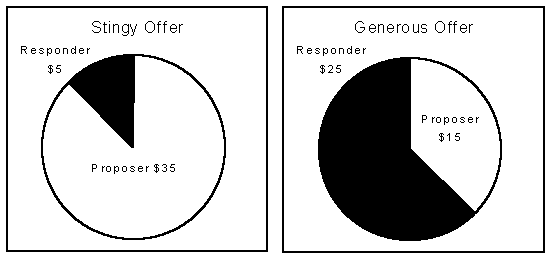
Figure 2: Feasible offers in “constrained” ultimatum game
The pairings for the ultimatum games were anonymous, but were known to be between members of the winner group the loser group. The pairings were different in the ultimatum game from the
pregame, and this also was told to the subjects. The roles of proposer and responder were randomized across the winning and losing treatment so that half of winners were proposers and half were responders and the same for losers.
Subjects were told they would play one of the two games for cash in one the two roles. In fact, all subjects were paid for their constrained ultimatum game strategies. The subject’s roles, the game played, the strategy of their opponent and cash payoffs were all revealed to the subjects 30 minutes after they had submitted their strategies.
Results
Tables 1 and 2 summarize behavior in the constrained ultimatum game. Recall that full strategies were elicited for all 26 subjects in both ultimatum game variants. 11 subjects chose the generous offer of $25 and 15 subjects chose to make stingy offers of $5. When asked for their strategy as responder, all 26 subjects accepted the Generous offer, and 20 accepted the Stingy offer.
|
Offer |
# |
|
Generous ($25 offer to responder) |
11 |
|
Stingy ($5 offer to responder) |
15 |
|
Total |
26 |
|
Response |
# |
|
Accept Stingy |
20 |
|
Reject Stingy |
6 |
|
Total |
26 |
In the unconstrained game, subjects were asked how much they would offer to the responder, and the minimum they would accept in the role of responder. The average offer was $13.73 and the average minimum acceptable offer was $7.12 (table 3).
|
|
N |
Std dev. |
|||
|
26 |
$1 |
$20 |
$13.73 |
$7.41 |
|
|
min acceptable offer |
26 |
$0 |
$15 |
$7.12 |
$5.44 |
Table 3: Offers and minimum acceptance amounts in unconstrained game.
Constrained and unconstrained strategies are similar
Players’ strategies in the two ultimatum game variants are similar. All of the subjects were paid for their choices in the constrained version and most of the following analysis focuses on the constrained strategies. It is important to compare the two games because there is a lot of published data on unconstrained ultimatum games, very little on constrained games of any form, and none on the exact version of the constrained game played here.
Players who were generous (offered $25) in the constrained game were also significantly more generous in the unconstrained game as compared to players who were stingy (offered $5) in the constrained game (p < 0.01, table 4). Among those who made generous offers in the constrained game, the minimum offer in the unconstrained game was $10. In contrast, eight of the fifteen subjects (53%) who made stingy offers in the constrained game made offers under $10 in the unconstrained game.
|
|
N |
Std dev. |
|||
|
11 |
0% |
$18.18 |
$3.37 |
$1.02 |
|
|
Stingy offer in constrained |
15 |
53% |
$10.47 |
$7.93 |
$2.05 |
Table 4: Offers in unconstrained game grouped by constrained offering behavior.
Players who were “proud” (rejected the stingy $5 offer) in the constrained game made higher demands in the unconstrained game as compared with players who were “practical” (accepted the stingy $5 offer) in the constrained game (p < 0.001, table 5). Among those who rejected $5 in the unconstrained game (the proud), the minimum acceptable offer was $10 in the unconstrained game. In contrast fifteen of the twenty subjects (75%) who accepted the stingy $5 offer in the constrained game (the practical) were willing to accept less than $10 in the unconstrained game.
|
|
N |
Std dev. |
|||
|
6 |
0% |
$13.33 |
$2.58 |
$1.05 |
|
|
Practical in constrained |
20 |
75% |
$5.25 |
$4.61 |
$1.03 |
Table 5: Minimum acceptable offers in unconstrained game grouped by constrained responder behavior.
In summary, behavior in the two ultimatum game variants is so closely correlated that subjects were almost unconstrained by the constraints.
Actual play for $
The 26 subjects played the $40 constrained ultimatum game as 13 pairs, all paid. The roles of responder and proposer were randomly selected. Seven of the proposers were stingy ($5 offers) and six were generous ($25 offers). Two of the seven stingy offers were rejected (table 6).
|
|
N |
|||
|
6 |
6 |
0 |
$15 |
|
|
Stingy offer |
7 |
5 |
2 |
$25 |
Table 6: Strategies and actual payoffs for subjects as played
Males making generous offers have higher Testosterone levels
Males who made generous offers ($25) had higher average Testosterone levels than males who made stingy offers ($5). With a p-value of 0.134 in a two-sided test, however, the difference is not statistically significant. Table 7 and figure 3 show base T levels (average from the three non-experimental days) and generous offers.
|
|
N |
|||
|
15 |
257 |
74 |
19 |
|
|
generous offer |
11 |
313 |
110 |
33 |
Table 7: Constrained offer strategy and testosterone levels.
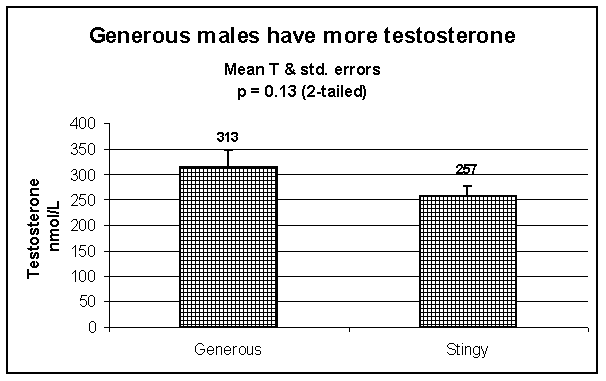
Figure 3: Constrained offer strategy
and testosterone level.
Males who reject stingy offers have higher Testosterone levels
Males who reject stingy offers (“proud”) have higher average Testosterone levels than males who accept stingy offers (“practical”). The p-value in a two-sided test is 0.001. Table 8 and figure 4 show base T levels (average from the three non-experimental days) and responses to $5 offer.
|
|
N |
|||
|
6 |
383 |
91 |
38 |
|
|
Practical (accept $5) |
20 |
251 |
71 |
16 |
Table 8: Constrained response strategy and testosterone levels.
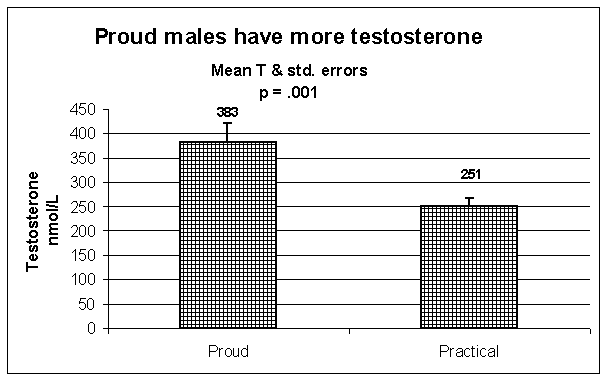
Figure 4: Constrained response strategy and testosterone levels.
The difference between high and low testosterone males can be seen most clearly by simply looking at the behavior. Appendix 3 ranks the subjects from highest to lowest testosterone. Five of the seven highest testosterone subjects rejected the stingy offer vs. only one of the remaining nineteen subjects.
Winning and Losing – the effect of the pre-game on hormones and behavior.
The pregame exercise of winning and losing did not generate the predicted testosterone changes. Table 9 contains a summary of the testosterone levels averaged for the 13 winners and 13 losers.
|
|
Base |
||||
|
326 |
275 |
284 |
-51 |
285 |
|
|
Losers (13) |
236 |
246 |
216 |
10 |
214 |
|
p-value (2-tailed) |
0.012 |
0.443 |
0.132 |
0.098 |
0.060 |
Table 9: Winner and Loser average testosterone levels (nmol/L)
Even though the assignment to groups was done randomly, the subjects assigned to winner status have higher base testosterone levels with a high level of significance (p=0.012). This appears to be just bad luck (for the experimenter).
The idea that winners would have testosterone rises relative to losers is not supported. In fact, the maximum difference comes 30 minutes after the coin flip where losers have higher testosterone relative to their own base levels (p=0.098). So if there is a difference between winners and losers it goes in the opposite direction from the hypothesis.
Why do these subjects not show the winner/loser effect seen in other studies? There are several possibilities. The first is that subjects are having some reversion to the mean. Winners were by chance higher testosterone than losers and have higher average absolute values at all 9 sampling points. The convergence during the experiment could therefore also reflect sampling variation. The argument against this view is that by the end of experiment, winners’ testosterone levels return to being significantly higher than losers and this is also seen in the final base reading 3 days after the experiment.
An alternate explanation is the “losers” felt like winners. Recall the specifics of the experiment; losers see winners receive $20 and then losers are given $25. The subjects were not asked what they thought about their relative payoffs, but it is possible that the “losers” believed they had been given $5 more than the “winners.”[2]
Did winners and losers behave differently? Table 10 contains a summary of the behavior in both ultimatum games organized by winner and loser status. There are no statistical differences between. Several regressions were run; in all there is no significant relationship between ultimatum game behavior and either changes in testosterone or winner/loser status. So winning and losing in game #1 has no effect on behavior in the ultimatum game.
|
|
||||
|
avg. offer |
avg. demand |
# generous (13 total) |
# proud (13 total) |
|
|
$15.15 |
$6.38 |
6 |
4 |
|
|
Losers (13) |
$12.31 |
$7.85 |
5 |
2 |
|
p-value |
> 0.25 |
> 0.25 |
> 0.25 |
0.15 |
Table 10: Winner and Loser strategies in ultimatum games
Discussion and Concluding Comments
Individuals’ testosterone level correlates with ultimatum game behavior. High testosterone males are less willing to accept small percentages in an ultimatum game, and are more likely to make generous offers. With 26 subjects, the statistics are compelling on the Responder behavior and borderline on the Proposer behavior.
One possible explanation for the
generosity result is that high testosterone males are simply being internally
consistent with their tough stance in demands. There are multiple ways to define consistency. One view is that an
internally consistent subject accepts the stingy offer if that is the offer he
made. Fifteen subjects made stingy offers and the other eleven made generous
offers. Two of the stingy subjects rejected the stingy offer vs. four of the
generous subjects. There is no statistical difference between these so a
subject's Proposer behavior does not help predict his Responder behavior.
Subjects in this study never saw or knew the identity of their counterpart. Furthermore, the ultimatum game is among the simplest strategic situations with a dominant strategy for purely self-interested responders. Finally, all of the subjects had taken at least two graduate microeconomics classes and were exposed to game theory. The anonymous, calm setting of this experiment with highly educated subjects would seem most likely to produce cerebral outcomes; Nevertheless, testosterone is strongly correlated with behavior. If testosterone is mediating behavior in this setting, it is likely to be more important in non-experimental settings.
REFERENCES
Booth, Alan; Shelley, Greg; Mazur, Allan and Tharp, Gerry. “Testosterone, and winning and losing in human competition.” Hormones & Behavior, 1989, 23(4), pp. 556-571.
Bribiescas, Richard. “Testosterone levels among Aché hunter/gatherer men: A functional interpretation of population variation among adult males.” Human Nature, 1996, 7, pp. 163-188.
Choi, Precilla Y. L. and Pope, Harrison G. “Violence toward women and illicit androgenic-anabolic steroid use.” Annals of Clinical Psychiatry., 1994, 6(1), pp. 21-25.
Dabbs, James M. “Testosterone measurements in social and clinical psychology. Special Issue: Social psychophysiology.” Journal of Social & Clinical Psychology, Fall 1992, 11(3), pp. 302-321.
Dabbs, James M.; Carr, Timothy S.; Frady, Robert L. and Riad, Jasmin K. “Testosterone, crime, and misbehavior among 692 male prison inmates.” Personality & Individual Differences, 1995, 18(5), pp. 627-633.
Dabbs, James M.; de la Rue, Denise and Williams, Paula M. “Testosterone and occupational choice: Actors, ministers, and other men.” Journal of Personality & Social Psychology, 1990, 59(6), pp. 1261-1265.
Dufty, AM. “Testosterone and survival: a cost of aggressiveness?.” Hormones & Behavior, 1989, 23(2), pp. 185-93.
Elias, M. “Serum cortisol, testosterone, and testosterone-binding globulin responses to competitive fighting in human males.” Aggressive Behavior, 1981, I, pp. 215-224.
Ellison, Peter T. “Human salivary steroids: methodological considerations and applications in physical anthropology.” Yearbook of Physical Anthropology, 1988, 31, pp. 115-142.
Ellison, Peter T. and Panter-Brick, Catherine. “Salivary testosterone levels among Tamang and Kami males of Central Nepal.” Human Biology Dec, 1996, 68(6), pp. 955.
Frank, Robert H. Passions Within Reason. New York: W. W. Norton & Company, 1988.
Gladue, Brian A.; Boechler, Michael and McCaul, Kevin D. “Hormonal response to competition in human males.” Aggressive Behavior, 1989, 15(6), pp. 409-422.
Guth, Werner; Schmittberger, Rolf and Schwarze, Bernd. “An Experimental Analysis of Ultimatum Bargaining.” Journal of Economic Behavior and Organization, December 1982, 3(4), pp. 367-388.
Hegner, R. E. and Wingfield, J. C. “Effects of experimental manipulation of testosterone levels on parental investment and breeding success in male house sparrows.” Auk, 1987, 104, pp. 462-469.
Hirshleifer, Jack. "On the Emotions as Guarantors of Threats and PromisesThe Latest on the best : essays on evolution and optimality. Cambridge, Mass: MIT Press, 1987, pp. 307-326.
Kemper, Theodore D. Social structure and testosterone: explorations of the socio-bio-social chain. New Brunswick: Rutgers University Press, 1990.
Kouri, Elena M. ; Lukas, Scott E.; Pope, Harrison G. Jr. and Oliva, Paul S. “Increased aggressive responding in male volunteers following the administration of gradually increasing doses of testosterone cypionate.” Drug & Alcohol Dependence, 1995, 40(1), pp. 73-79.
Mazur, Allan. “A biosocial model of status in face-to-face primate groups.” Social Forces, 1985, 64(2), pp. 377-402.
Mazur, Allan ; Booth, Alan and Dabbs, James M. “Testosterone and chess competition.” Social Psychology Quarterly, March 1992, 55(1), pp. 70-77.
McCaul, Kevin D.; Gladue, Brian A. and Joppa, Margaret. “Winning, losing, mood, and testosterone.” Hormones & Behavior, 1992, 26(4), pp. 486-504.
Robbins, Martha and Czekala, Nancy. “Preliminary investigation of urinary testosterone and cortisol levels in wild male mountain gorillas.” American Journal of Primatology, 1997, 43(1), pp. 51-64.
Roth, Alvin E. "Bargaining Experiments." in John H. Kagel and Alvin E. Roth, eds., Handbook of experimental economics. Princeton, NJ: Princeton University Press, 1995, pp. 253-348.
Salvador, Alicia; Simon, Vicente; Suay, Fernando and Llorens, Luis. “Testosterone and cortisol responses to competitive fighting in human males: A pilot study.” Aggressive Behavior, 1987, 13(1), pp. 9-13.
Schelling, Thomas. “Altruism, Meanness and Other Potentially Strategic Behaviors.” American Economic Review, May 1978, 68(2), pp. 229-30.
Silverin, B. “Effects of long-acting testosterone treatment on free-living pied flycathcers, Ficedula hyupoleuca,during the breeding period.” Animal Behavior, 1980, 28, pp. 906-912.
Wingfield, J.C. “Androgens and mating systems: Testosterone-induced polygyny in normally monogamous birds.” Auk, 1984, 101, pp. 665-671.
Wrangham, Richard W. and Muller, Martin N. “Endocrine aspects of aggression and dominance in chimpanzees.” National Science Foundation grant application, 1996.
Appendix 1: Instructions for Game 1: Generating Winners and Losers
Match
the Number
You have been paired by randomization with another person. You will be competing for $20. Your goal is to match a one digit number of the experimenters. Specifically you and your opponent will each pick three, one digit numbers (0-9).
The experimenters will then announce a one digit number; if exactly one player matches the experimenter, he is the Winner. If neither player, or both players, match the experimenter, the Winner and Loser will be decided by coin flip.
Examples:
You: Opponent: Experimenter Winner Loser
0, 3, 7 0, 8, 9 3 You Opponent
1, 8, 9 2, 3, 5 0 Coin flip (neither match)
7, 8, 9 1, 8, 9 9 Coin flip (both match)
Circle your three numbers here, After you have picked your numbers you may not change them.
0 1 2 3 4 5 6 7 8 9
The experimenters’ numbers have been pre-determined by an
undisclosed process.
Appendix 2: Instructions for Game 2: Ultimatum Game
Exercise
#2
You have been randomly paired with a person in the other room. The person you have been paired with is not the person that you played against in “Match the Number”.
In this portion of the experiment, a sum of $40 has been provisionally allocated to each pair. One person, the “proposer”, will propose a division of the $40. The second person, the “responder”, decides if the division is acceptable. If the responder accepts, then the money will be paid. If the responder rejects, both the responder and the proposer will receive $0 for this part of the experiment.
You will be playing one of two variants of this game in the role of proposer or the role of responder. Variant one, “unconstrained”, allows you to propose any division of the $40. Variant two, “constrained”, forces you to choose one of two offers. Offer #1 proposes $15 for yourself and $25 for your counterpart. Offer #2 proposes $35 for yourself and $5 for your counterpart.
The payoffs are as follows. One of the two variants will be picked, and you will be assigned randomly to the role of proposer or responder. Your decision will be combined with that of your counterpart and the proposal will either be accepted or rejected.
In the unconstrained variant, the amount the proposer allocates to the responder will be compared to the minimum that the responder will accept. If the proposer’s offer is greater than the minimum required by the responder, the proposer’s offer is accepted.
In the constrained variant, the proposer will have chosen one of the two offers. The responder’s decision on that offer will be either accept or reject and that will be the outcome.
Your decision will remain private; the experimenters will never divulge your individual decision. You simply fill out the form and hand it to the experimenters. You will be paid confidentially as soon as all the proposals and responses have been paired.
Your name: ___________________________
Unconstrained choice:
Your decision if you are the Proposer:
Amount you propose to keep for yourself ($0-40) ___________
Amount you propose to allocate to your counterpart ___________
Total= $40
Your decision if you are the Responder:
Minimum you will be willing to accept ($0-40) ___________
Constrained choice:
Your decision if you are the Proposer: Circle one of:
Propose: $15 for yourself and $25 for your counterpart, or
Propose: $35 for yourself and $5 for your counterpart
Your decision if you are the Responder:
Circle accept or reject on each
line:
If Proposer offers me $25, I will: Accept Reject
If Proposer offers me $5, I will: Accept Reject
Appendix 3: Testosterone levels and Ultimatum Game Behavior
|
Testosterone (nmol/L) |
Proposer behavior “generous” - offer $25 out of $40 |
Responder behavior “proud” - reject $5 of $40 “practical” accepts $5 |
|
497 |
generous |
proud |
|
468 |
generous |
proud |
|
439 |
stingy |
practical |
|
387 |
generous |
proud |
|
362 |
stingy |
proud |
|
361 |
generous |
practical |
|
338 |
generous |
proud |
|
321 |
stingy |
practical |
|
296 |
generous |
practical |
|
293 |
stingy |
practical |
|
282 |
stingy |
practical |
|
265 |
stingy |
practical |
|
265 |
generous |
practical |
|
262 |
generous |
practical |
|
252 |
stingy |
practical |
|
251 |
practical |
|
|
244 |
stingy |
proud |
|
239 |
stingy |
practical |
|
219 |
practical |
|
|
210 |
stingy |
practical |
|
202 |
stingy |
practical |
|
199 |
stingy |
practical |
|
169 |
generous |
practical |
|
167 |
stingy |
practical |
|
165 |
stingy |
practical |
|
153 |
generous |
practical |